
What Kinds of Soils Cause Settling?
Get Your Free EstimateEvery kind of soil is able to cause settling. There are various types of soils that are used as foundations for buildings, both commercial and residential. Each has their own positive and negative characteristics. The sort of soil that is utilized for construction is usually picked by the site manager, not the owner of the property. The site manager chooses which kind of soil based on their own preference, the kind of property that’s constructed, and what the climate is like in the area they are working in.
Soil that is made of 10% or more clay is the kind of soil most likely to cause settling. That said, other kinds of soil either shrink and compact or erode in their own way based on their structural integrity. North Carolina’s state soil is called Cecil soil. The topsoil is loam but the rest is clay, which makes for a great combination of soil types for foundations. However, these two kinds of soils are able to cause settling despite their amazing properties.
- Clay Soils and Loam
The more clay present in the soil, the more it’s able to expand once it comes in contact with moisture. Just as it’s able to swell exponentially when wet, it’s also able to experience extreme levels of shrinkage once its moisture content dries up. You might be wondering why builders still use clay soils, given their swell-shrink capacity, but they do have their advantages. Clay soils stick together very well, and they are easier to compact, so they become proper, solid foundations quicker than other kinds of soils.
As for loam, it’s considered the best kind of soil to use as a foundation. It’s a mixture of different kinds of soils, and it has just the right amount of clay to compact easily without the extreme swell-shrink capacity of clay-rich soils. This is why Cecil soil works so well as a foundation: A low-expansion topsoil that rests atop dense clay soil is a pair that holds up for years to come. That said, loam still has clay in it, so shrinkage is still going to occur.
- Sand and Gravel
Sand and gravel might seem like the solution to soil shrinkage, but even these kinds of foundations have their faults. Sand has no clay content, so it does not compact well. Because of this, it’s loose and shifty. North Carolina may not suffer major earthquakes, but the earth is constantly trembling. There can be an average of 10 small earthquakes in a single month, and this affects all foundations, especially the ones that are a bit looser.
Something very similar occurs if the foundation is made of gravel. The particles are too large, so water streams directly through it all. When the water evaporates, the gravel will stay in place, but there’s still a lot of room left over for shifting. Sand and gravel are not used as foundations in areas that experience frequent, strong earthquakes precisely for this reason. Settling caused by shrinkage can be fixed with polyurethane injections, but a shifty concrete can bring an entire building down.
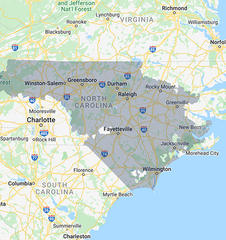
Our Locations
3400 Walsh Pky, Suite 220
Fayetteville, NC 28311
611 Summit Ave, Suite 5
Greensboro, NC 27405
8005 Knightdale Blvd
Knightdale, NC 27545
2155 Enterprise Dr. NE
Leland, NC 28451
2910 Griffith Rd
Winston-Salem, NC 27103