
What Causes Concrete Pitting and Flaking?
Many homeowners aren’t sure why their concrete suddenly has craters or why it’s flaking off, especially if the concrete was placed in a part of the house that isn’t used much. This has to do with the idea that concrete is an unmovable, difficult-to-break material that only cracks under extreme pressure. However, concrete experiences breakage even when left on its own after a few decades.
The material isn’t as tough as it may seem. A big part of concrete’s vulnerability begins from the time the concrete mixture is made.
- The Freeze-Thaw Effect
Flaking is caused by the freeze-thaw effect, in which water that seeps through the concrete freezes and expands. When water freezes and changes its state from liquid to solid, it expands by about 9 percent and puts pressure on the concrete’s surface. If the pressure exceeds the concrete’s tensile limit, the concrete particles get displaced.
This occurs because of how porous concrete is. The water under the very surface of the concrete gets frozen and lifts the concrete up. Now detached, the concrete layer is able to flake off at the slightest touch. During winter, the freeze-thaw cycle is in full effect. Driveways in particular are vulnerable to flaking during the winter because of the shovels flaking off the already vulnerable concrete. This is why it’s important that contractors make high-strength concrete in places where it snows since stronger concrete is less permeable.
- Concrete Mixture
The way the concrete is mixed has a huge impact on its color, stability, and strength. All concrete deteriorates over time, but if the concrete is pitting and flaking less than five years after it was poured, it was caused by an inadequate mixture. Contractors should make their mixtures based on the area’s climate.
Low-strength concrete is more permeable. It would be all right to make low-strength concrete in a state like California, where it doesn’t rain or snow heavily. Low-strength concrete shouldn’t be used in a state like North Carolina, where it gets cold enough that the concrete goes through the freeze-thaw cycle.
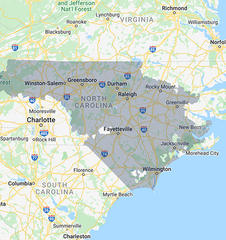
Our Locations
3400 Walsh Pky, Suite 220
Fayetteville, NC 28311
611 Summit Ave, Suite 5
Greensboro, NC 27405
8005 Knightdale Blvd
Knightdale, NC 27545
2155 Enterprise Dr. NE
Leland, NC 28451
2910 Griffith Rd
Winston-Salem, NC 27103