
Does My Crawl Space Need to Be Insulated?
Before the plastic vapor barrier is applied, the crawl space must be insulated. To insulate a space, contractors must fill in the gaps and crevices with a certain material that will either reflect heat or absorb it. This is used to control the flow of heat in a home.
Crawl spaces do need to be insulated because the air inside interacts with the air in your home via the stack effect. There are two ways a space can be insulated. One form of insulation is better than the other, however, so read further so you can know to choose a contractor that provides the best option.
- Absorbent Insulation
Fiberglass insulation is the industry standard when it comes to insulation. However, this doesn’t mean it’s the best or most effective insulation method. Fiberglass consists of extremely fine glass fibers. It’s a very soft material that is highly absorbent, so it absorbs heat pretty well. The only problem is that it absorbs moisture as well.
When the fiberglass insulation in a crawl space absorbs moisture, it grows mold. As the fiberglass insulation absorbs more and more moisture, it gets heavier due to the weight of the water. Eventually, the insulation falls off, especially if it wasn’t placed correctly. Fiberglass insulation is still widely used in homes, but it has no place in an area as humid as a crawl space. Before hiring a contractor to waterproof a crawl space, make sure to ask what kind of insulation method will be used.
- Reflective Insulation
The best kind of insulation for naturally humid areas are those with reflective tendencies. Reflective insulation panels and materials are those which control airflow in a space, not by absorbing heat, but by reflecting it. This keeps the heat inside the crawl space while still ensuring the actual insulation material stays dry and lasts for years.
A good example of reflective insulation material is ExTremeBloc™. It’s made of polystyrene foam and it’s infused with graphite. An insulation material’s effectiveness is measured in terms of its R-value (also known as thermal resistance). Fiberglass insulation has an R-value of 2.2 to 2.7 per inch. Meanwhile, polystyrene foam insulators like ExTremeBloc™ have an R-value of 11.
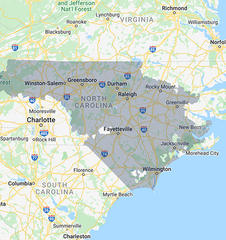
Our Locations
3400 Walsh Pky, Suite 220
Fayetteville, NC 28311
611 Summit Ave, Suite 5
Greensboro, NC 27405
8005 Knightdale Blvd
Knightdale, NC 27545
2155 Enterprise Dr. NE
Leland, NC 28451
2910 Griffith Rd
Winston-Salem, NC 27103